Post
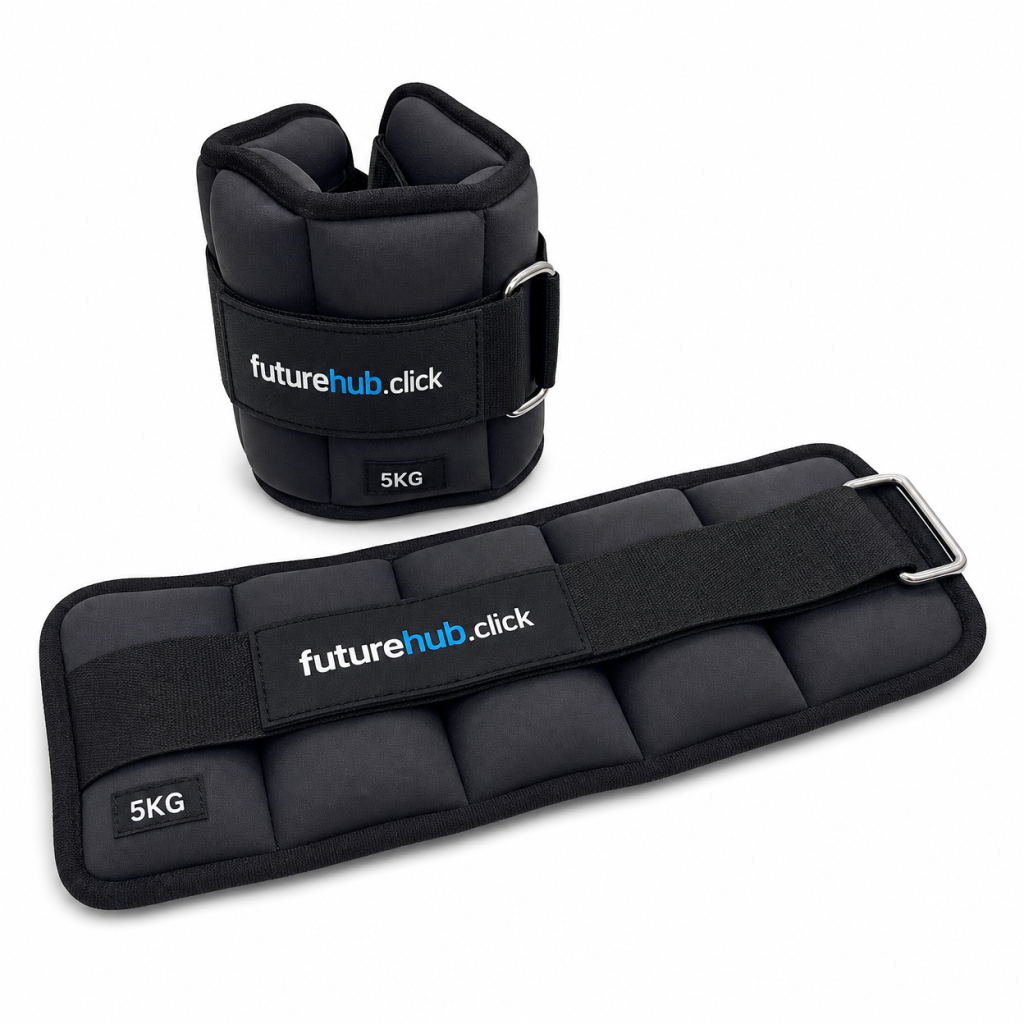
Ankle Weights Pair 5kg
May
Ankle weights occupy a unique space in the fitness equipment landscape. Deceptively simple in design, they can be strapped on and worn during a wide range of activities, turning ordinary movements into strengthening exercises. A 5kg pair represents a meaningful resistance challenge suitable for a broad range of training applications, from rehabilitation to athletic performance enhancement.
**Design and Construction**
Quality ankle weights consist of a fabric cuff — typically neoprene, canvas, or nylon — that wraps around the ankle and secures with a velcro closure. Inside the cuff, sand or metal shot fills pockets distributed evenly around the ankle circumference to prevent the weight from shifting or creating imbalance during movement.
The 5kg rating applies to each individual ankle weight, giving a combined load of 10kg when both are worn simultaneously. Some models use individual iron or steel plates inserted into pockets, allowing you to start at a lower weight and gradually add resistance as your strength develops. This adjustability makes such designs considerably more versatile and long-lasting as training tools compared to fixed-weight models.
The fit and security of the fastening system is critically important. A poorly designed closure that allows the weight to shift or bounce during movement not only reduces training effectiveness but can cause the ankle to track abnormally, potentially contributing to joint stress or muscle imbalances. Look for wide velcro closures that distribute clamping pressure evenly and hold firmly without restricting circulation.
**Primary Training Applications**
Ankle weights were originally developed for lower extremity rehabilitation following injury or surgery. Their ability to add resistance to leg movements without requiring the hands to hold anything makes them ideal for therapeutic exercises performed lying on a treatment table or mat, where free weights would be awkward or unsafe.
Leg raises performed while lying on your back target the hip flexors and lower abdominals with or without ankle weights, but the addition of 5kg transforms these from a light activation exercise into a genuine strength challenge. Side-lying leg raises target the hip abductors and tensor fascia latae, muscles critical for knee stability and lateral movement athletic performance. Prone hip extensions, performed lying face down and lifting one straight leg toward the ceiling, develop the gluteus maximus with minimal lower back involvement.
Standing ankle weight exercises add a new dimension. Donkey kicks, fire hydrants, standing side leg raises, and hip abduction movements performed while holding a stable support for balance become significantly more demanding with a 5kg cuff on the working ankle. These exercises are foundational to the glute activation protocols used by physical therapists and sports performance coaches worldwide.
**Walking and Low-Impact Cardio Applications**
Wearing ankle weights during walking has been studied as a method for increasing caloric expenditure and strengthening the hip flexors and extensor muscles through the natural gait cycle. The additional weight increases the metabolic cost of each step, making a standard walk more challenging and effective for cardiovascular conditioning.
However, this application requires important caution. For joint health and injury prevention, ankle weights during walking are most appropriate at lighter loads (1 to 2kg per ankle). Using heavy ankle weights — including the 5kg model discussed here — during extended walking can alter gait mechanics, increase impact forces through the knee and hip, and contribute to overuse injuries. The 5kg pair is better reserved for controlled, targeted exercises than for prolonged ambulatory activities.
For low-impact exercise like cycling, ankle weights add resistance to the pedaling motion and increase the demand on the quadriceps, hamstrings, and calves. Used on a stationary bike or during outdoor cycling on flat terrain, they can supplement a training session effectively.
**Core and Stability Training Integration**
Ankle weights extend the challenge of many core and stability exercises significantly. The hanging leg raise family of exercises, performed on a pull-up bar or captain’s chair, becomes dramatically more difficult with ankle weights providing added resistance. The longer moment arm created by the additional weight far below the hip joint creates substantial loading on the hip flexors and abdominals.
Balance training exercises performed on one leg, such as single-leg standing, single-leg Romanian deadlifts with bodyweight, or single-leg squat drills, are all made more challenging and therapeutic by the destabilizing effect of an asymmetric ankle weight. This added challenge develops the proprioceptive systems of the ankle and knee and builds the stabilizer muscles that protect these joints during athletic activities.
**Rehabilitation and Physical Therapy Uses**
In rehabilitation settings, ankle weights are among the most frequently prescribed strengthening tools for recovery from knee surgery, particularly ACL reconstruction. The quadriceps and hamstrings that stabilize the knee joint must be systematically strengthened during the recovery process, and ankle weights provide a simple, controllable method for progressive loading of terminal knee extension and leg curl exercises.
Hip labral tears, IT band syndrome, and patellofemoral pain syndrome all benefit from specific glute strengthening exercises that ankle weights facilitate. The ability to perform these rehabilitative movements at home between physical therapy sessions accelerates recovery and reduces the total treatment duration.
**Conclusion**
Ankle weights at 5kg per side represent a practical, affordable, and highly versatile training tool with applications spanning rehabilitation, general fitness, athletic conditioning, and core training. Their ability to be worn during a wide range of movements makes them uniquely flexible among resistance training tools. Used thoughtfully and progressively, they add a powerful dimension to any training program. Biomechanical Effects: Wearing ankle weights fundamentally changes movement mechanics by increasing the moment arm about joints. A 5kg ankle weight creates moment of force several times greater than static weight due to extended lever arm. The increased moment demands additional recruitment of hip flexor muscles to overcome rotational resistance. Over months with ankle weights these muscles adapt developing greater strength and size. Proprioceptive Development: Asymmetric loading during single-leg exercises creates balance demands that develop proprioceptive sensitivity. Your system must continuously adjust position to maintain balance. Research shows athletes who train balance demonstrate superior injury prevention. Application to Sports: Ankle weights enhance athletic performance in sports involving kicking. Martial artists develop tremendous kicking power. Soccer players develop more powerful shots.
