Post
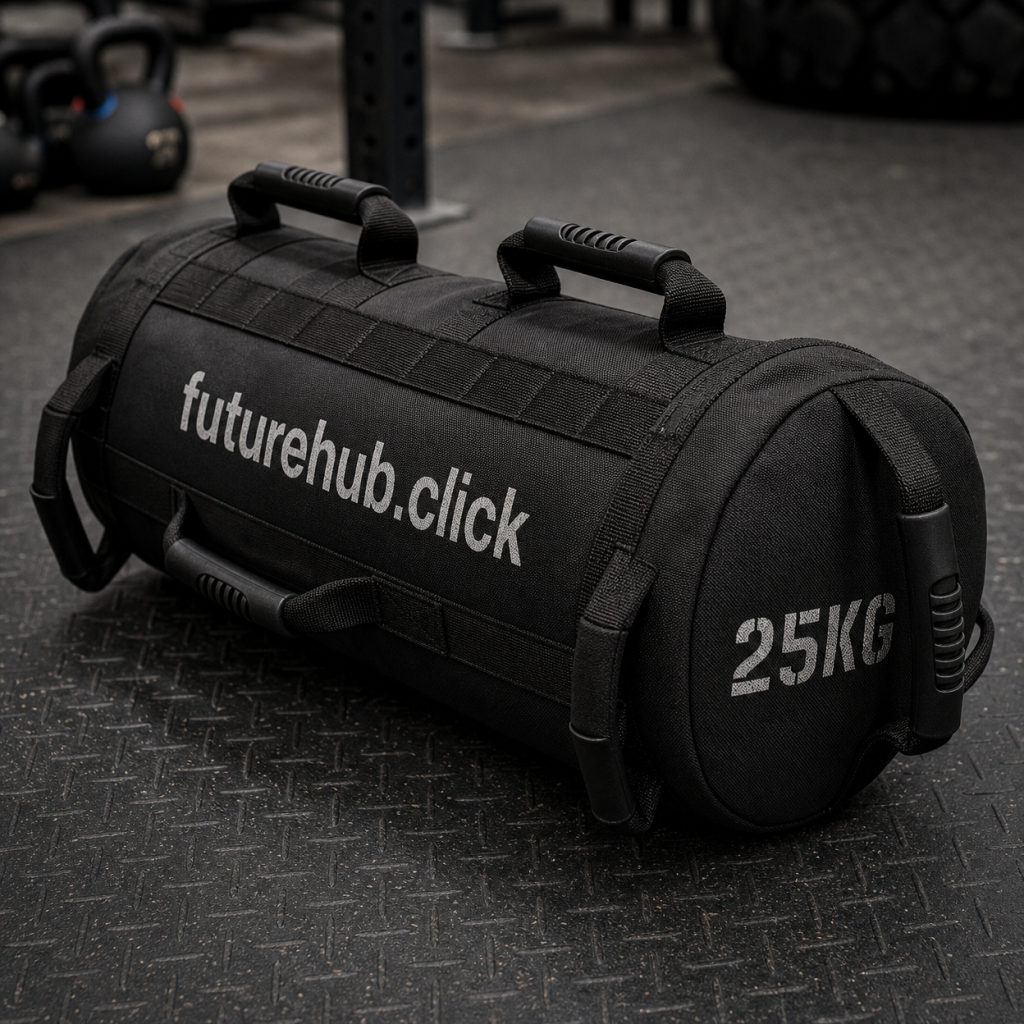
Workout Sandbag 25kg
May
In the world of functional fitness, the sandbag occupies a unique and important position. It does not provide the predictable, fixed resistance of barbells and dumbbells. It shifts, moves, and deforms as it is lifted, carried, and thrown, creating training demands that no other implement can replicate. A 25kg workout sandbag is heavy enough to challenge even strong, experienced athletes across a wide range of exercises, making it one of the most valuable functional training tools available.
**What Makes Sandbag Training Unique**
The defining characteristic of sandbag training is the shifting, unpredictable nature of the load. When sand moves inside the bag during a lift, your muscles must continuously adapt to the changing center of mass, activating stabilizing muscles and demanding constant proprioceptive attention. This is fundamentally different from lifting a barbell of equivalent weight, where the load is fixed and the resistance curve is entirely predictable.
This unpredictability more closely mimics the demands of real-world physical work and athletic activity. In sports, a defensive player does not move in perfect, predictable arcs. In manual labor, an object being carried shifts weight in response to movement. The sandbag trains the neuromuscular system to handle dynamic, uncertain loads in a way that transfers directly to functional performance.
Research comparing barbell and sandbag training suggests that sandbag exercises produce greater activation in the core musculature due to the need for continuous trunk stabilization against the shifting load. The grip demands are also significantly greater with sandbags due to their unusual shape and the tendency of the bag to rotate or compress in the hands.
**Types and Quality of Workout Sandbags**
Training sandbags differ significantly from construction sandbags, which are made from jute or polypropylene and are not designed for repeated dynamic loading in fitness contexts. Dedicated workout sandbags are made from heavy-duty ballistic nylon or 1000-denier cordura with reinforced stitching at all stress points, multiple carrying handles positioned at different locations on the bag, and an outer shell that contains inner filler bags.
The inner filler bag system is an important safety and practicality feature. Rather than filling the outer shell directly with sand — which could flood the training area if the outer shell tears — the sand is contained in robust inner bladders. This means that even if the outer shell sustains damage, the sand remains contained and the bag can continue to be used safely until the outer shell is repaired or replaced.
Multiple handles — typically top loop handles, side handles, and sometimes shoulder carry handles — are essential for accessing the full range of sandbag exercises. Different handle positions change the mechanics and challenge of exercises in significant ways, allowing comprehensive training from a single implement.
**Training Applications at 25kg**
A 25kg sandbag provides substantial challenge across the foundational movement patterns of strength training. Sandbag cleans — lifting the bag from the ground to shoulder level in a hip-driven movement — develop explosive hip extension and the pulling mechanics used in Olympic weightlifting, but with the additional core challenge of managing a shifting load at the top of the movement.
Shouldering, where the bag is lifted from the ground and positioned on one shoulder, is a uniquely functional movement pattern that challenges rotational strength and single-shoulder stability under significant load. Alternating shoulders throughout a training set develops bilateral strength symmetry and comprehensive shoulder stability.
Sandbag carries — walking with the bag in various positions including front-loaded bear hug carry, over-the-shoulder carry, and single-hand carrying — develop cardiovascular conditioning, grip strength, core stability, and total body muscular endurance simultaneously. These loaded carry variations are among the most effective functional fitness exercises available.
Sandbag squats, front squats, overhead presses, and bent-over rows provide the foundational strength exercises of a complete program. The shifting load and unusual dimensions of the sandbag make each of these exercises distinctly more challenging than the barbell equivalent, as the body cannot rely on familiar movement patterns and must continuously adjust.
**Outdoor and Unconventional Training**
One of the most compelling advantages of a workout sandbag is its suitability for outdoor and unconventional training environments. Unlike barbells and dumbbells, a sandbag can be dragged across grass, thrown against a hill, carried upstairs, or used in muddy conditions without concerns about rust or damage.
This outdoor applicability makes sandbags ideal for training in parks, on beaches, in backyards, or on any terrain. The terrain itself adds challenge — performing lunges uphill with a sandbag on your back creates a completely different experience from the same movement on a flat gym floor, engaging the ankle stabilizers and creating cardiovascular demand that controlled environments cannot replicate.
**Filling and Maintenance**
A 25kg sandbag can be filled with fine-grained play sand, rubber crumb, or purpose-made fitness bag filler. Fine sand is the traditional fill that provides the most fluid shifting quality but also creates the most dust if a seal is compromised. Rubber crumb filler is more expensive but cleaner and odor-free, making it preferable for indoor training.
Never fill a sandba fully, as a completely full bag has little shifting quality and becomes extremely difficult to manage. Filling to 70 to 80 percent capacity maintains the dynamic quality that makes sandb training distinctive while allowing the filler to move in response to the exercises.
**Conclusion**
A 25kg workout sandba is a demanding, versatile, and authentically functional training tool that builds a quality of strength and resilience that conventional equipment cannot fully develop. Its shifting load demands continuous adaptation, its outdoor durability expands training options, and its wide range of exercise applications makes it relevant at any stage of physical development. For serious functional fitness, the sandba deserves a permanent place in your training arsenal. Advanced Programming: Sandba training integrates into sport-specific conditioning because unpredictable load matches sport demands. A football player develops ability to generate force against unpredictable resistance. Metabolic Stress: Sandba training creates significant metabolic stress through heavy load and unstable surface. The nervous system expends additional energy maintaining stability. This increases overall metabolic demand beyond equivalent barbell work. Environmental Versatility: Sandba compatibility with outdoor environments makes it ideal for athletes lacking gym access. Parks beaches trails and backyards become viable locations. Outdoor training with varied terrain adds proprioceptive and balance demands.
