Post
Captains Chair Leg Raise
May
Among all the equipment designed specifically for abdominal and core training, the captain’s chair stands out as one of the most scientifically validated and practically effective options available. Biomechanical research comparing the muscle activation of dozens of abdominal exercises consistently places the captain’s chair leg raise among the top performers for rectus abdominis and oblique engagement.
**What Is a Captain’s Chair?**
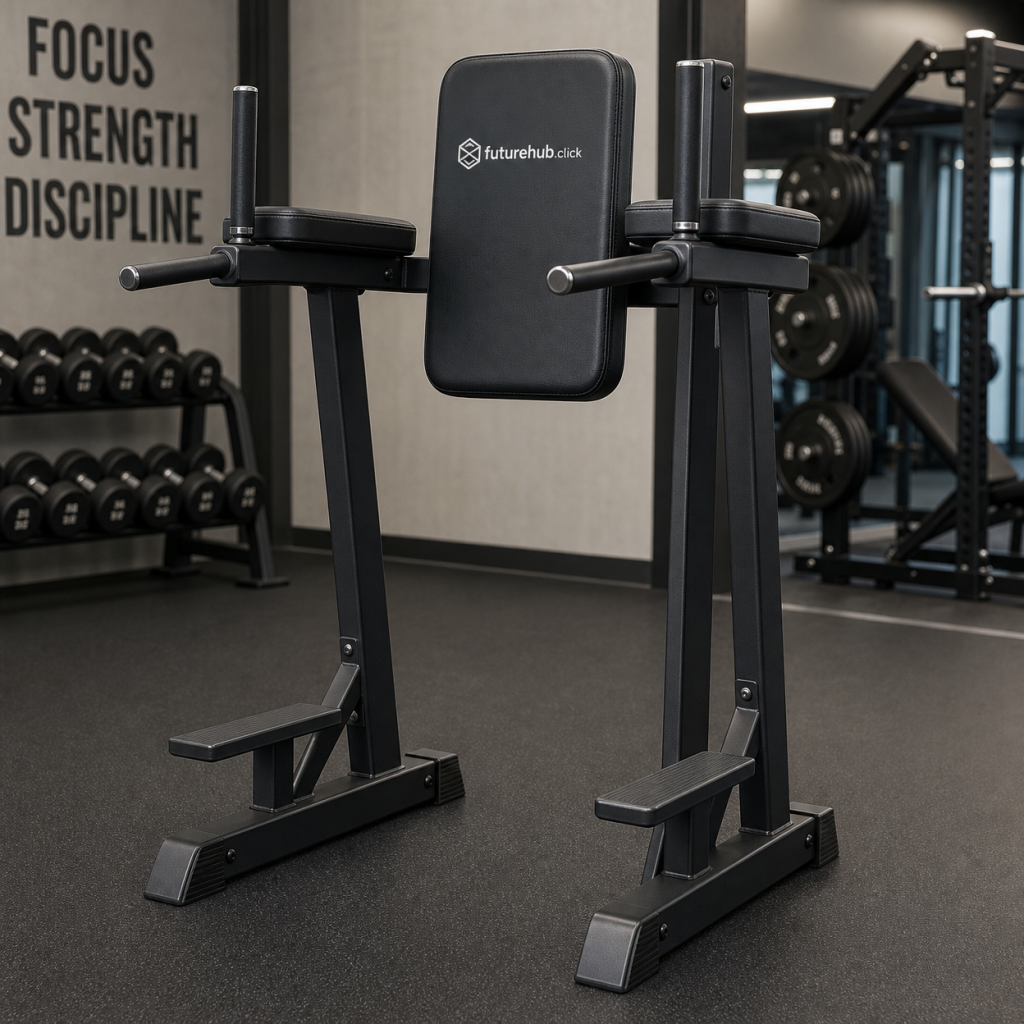
A captain’s chair, sometimes called a power tower when combined with pull-up and dip stations, is a freestanding piece of equipment featuring two padded armrests and a padded backrest. The user supports themselves with their forearms on the armrests, their back against the backrest, and their legs hanging freely below them. From this suspended position, they raise their legs, performing either bent-knee raises or straight-leg raises depending on their fitness level and training goal.
The design allows for complete suspension of the lower body, eliminating hip flexor dominance that occurs in floor-based exercises like sit-ups and crunches. When the legs are raised against gravity from a hanging position, the rectus abdominis must generate significant force to flex the lumbar spine and pelvis, while the hip flexors contribute differently than in floor exercises. This distinction makes the captain’s chair particularly valuable for developing true abdominal strength rather than simply training the hip flexors to move the torso.
**Muscle Activation and Research**
The American Council on Exercise sponsored a widely cited study examining electromyographic activity during 13 common abdominal exercises. The captain’s chair leg raise ranked second overall for rectus abdominis activation and first for oblique activation, outperforming the traditional crunch, decline crunch, ab wheel rollout, and numerous other exercises that are considered staples of core training.
This extraordinary oblique activation makes the captain’s chair particularly valuable for developing rotational strength and lateral trunk stability, which are essential for athletic performance and spinal health. The obliques are the primary drivers of rotation and lateral flexion, and their development is often overlooked in training programs that focus exclusively on forward flexion movements like crunches and sit-ups.
**Progressions from Beginner to Advanced**
The captain’s chair accommodates all fitness levels through a natural progression of exercise difficulty. Beginning with bent-knee raises, where the knees are drawn toward the chest, is the appropriate starting point for most people. This reduces the moment arm of the movement and minimizes the demand on the hip flexors, allowing the abs to do the majority of the work.
Progressing to straight-leg raises significantly increases the challenge by extending the moment arm of the legs. The longer lever creates much greater resistance that the abs must overcome, producing substantially more muscle activation and strength development. However, straight-leg raises require adequate hamstring flexibility and hip flexor strength to perform correctly without compensatory lower back arching.
Advanced variations include windshield wipers, where straight legs are raised to horizontal and then rotated from side to side, creating exceptional oblique loading. Pike progressions, where the legs rise past horizontal toward a vertical position, challenge upper abdominal and hip flexor strength. Weighted leg raises, performed with a dumbbell held between the feet or a medicine ball gripped between the ankles, add resistance for advanced practitioners who have maxed out the difficulty of bodyweight variations.
**Proper Technique for Maximum Results**
Common technical errors significantly reduce the effectiveness of captain’s chair exercises and can contribute to lower back strain. The most frequent mistake is excessive swinging, where momentum from the previous repetition drives the legs upward rather than muscular contraction. Controlled, deliberate repetitions where the legs lower under full muscular control and pause briefly at the bottom before initiating the next rep produce far superior results.
Maintaining posterior pelvic tilt during the entire movement is critical. At the bottom position, there is a natural tendency to allow the lower back to arch, which puts the abs in a mechanically disadvantaged position and increases lumbar stress. Before initiating each repetition, consciously pull the naval toward the spine and tilt the pelvis posteriorly, keeping the lower back flat against or slightly away from the backrest.
Breathing should be exhaled forcefully as the knees or legs rise, with inhalation during the controlled lowering phase. This breathing pattern maintains intra-abdominal pressure appropriately and prevents the Valsalva maneuver that novices sometimes inadvertently perform during difficult abdominal exercises.
**Integration into Training Programs**
Captain’s chair exercises are most effective when integrated into a comprehensive core training program that includes exercises for all planes of motion. Combining vertical hanging exercises with plank variations for anti-extension training, side planks and pallof presses for anti-lateral flexion, and rotational exercises creates a balanced approach that develops functional core strength rather than merely aesthetic abdominal definition.
For most training programs, two to three sets of 10 to 20 repetitions, depending on the variation being used, performed two to three times per week, provides an optimal stimulus for strength and endurance development. As proficiency increases, manipulating the progression ladder described above maintains the training stimulus.
**Conclusion**
The captain’s chair leg raise is not just another ab exercise; it is one of the most effective tools for developing the deep core strength that underpins athletic performance, spinal health, and physical longevity. Its scientific validation, natural progression system, and capacity for advanced variation make it relevant at every stage of fitness development. Any home gym or training space equipped with a captain’s chair has a foundational core training tool that will deliver results for decades. Biomechanical Analysis: The captain’s chair leg raise activates core musculature through a completely different pattern than floor exercises. When performing crunches your upper body remains supported. The captain’s chair eliminates this pattern because your upper body remains stationary while your lower body moves against gravity. Research shows activation patterns that exceed traditional crunches by 300-400 percent. The hanging position creates a fundamentally different loading pattern. Additionally activation is distributed more evenly across the entire muscle. The oblique activation during leg raises far exceeds activation achieved through traditional twisting crunches. Anti-Rotation Training: The captain’s chair develops anti-rotation core strength—the ability to resist rotational forces. In sports the ability to resist unwanted rotation is as important as producing rotational movement. Spinal Health: The deep core muscles developed through this training provide the muscular foundation that protects the lumbar spine from injury.
