Post
Smith Machine Home Gym
May
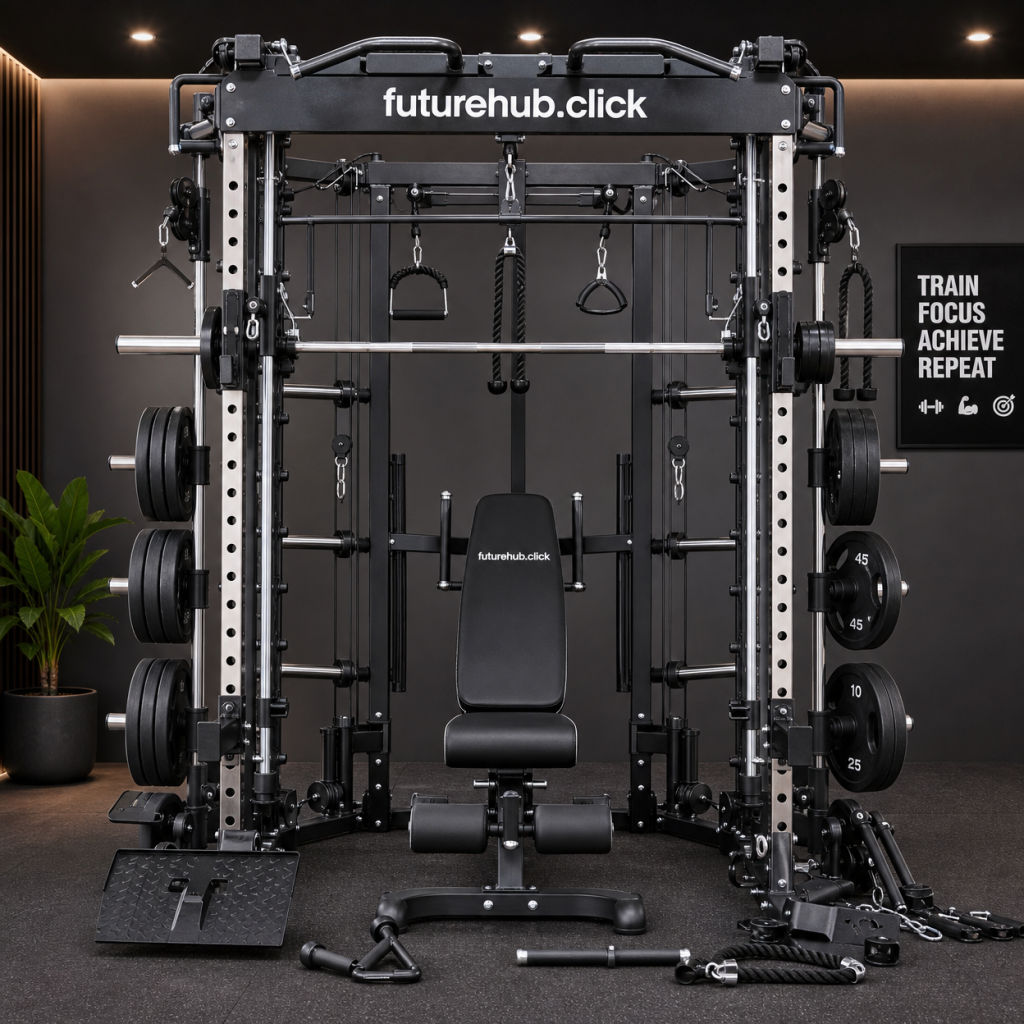
The Smith machine has been a staple of commercial gyms for decades, and now an increasing number of fitness enthusiasts are bringing this powerhouse piece of equipment into their homes. A Smith machine home gym combines the guided barbell system with additional cable attachments, pulleys, and sometimes a full power rack, creating an all-in-one training station capable of hundreds of exercises.
**Understanding the Smith Machine**
At its core, a Smith machine consists of a barbell that is fixed within vertical steel rails, allowing it to travel only in a straight up-and-down path. Most modern Smith machines incorporate a slight backward angle of about seven degrees to more closely mimic the natural arc of a free-weight barbell press. The bar can be locked at various heights by rotating it so that hooks catch on the rail notches, making it possible to safely re-rack the weight at any point during a set.
This guided movement offers several important advantages. The most significant is safety: if you fail on a squat, bench press, or overhead press, you can quickly lock the bar at any point without needing a spotter. This is particularly valuable for solo training at home, where the risk of being trapped under a heavy barbell with no assistance is a real concern.
**Components of a Home Smith Machine System**
A full Smith machine home gym goes well beyond just the guided barbell. Premium models include a cable pulley system with high and low cable stations, allowing you to perform lat pulldowns, cable rows, tricep pushdowns, cable crossovers, face pulls, and dozens of other cable-based exercises. The combination of the Smith bar and functional cables in a single unit maximizes the exercise variety per square foot of floor space.
Many home Smith machine systems also incorporate a chin-up and pull-up bar across the top of the frame, a dip station, and a landmine attachment. Some models include a leg press platform, a pec deck attachment, or an adjustable cable arm that allows for multi-directional resistance. Evaluating which attachments are included versus which must be purchased separately is crucial when comparing different models.
The weight stack or plate loading system is another defining characteristic. Some Smith machines use a traditional plate-loaded barbell, while others incorporate a weight stack connected by cables. Plate-loaded systems allow you to use the same weight plates across multiple pieces of equipment and tend to feel more similar to free-weight training, while weight stack systems are quicker to adjust and more compact.
**Training Advantages of the Smith Machine**
One area where the Smith machine excels is for beginners learning the fundamental movement patterns of compound lifts. The guided path removes the stabilization demands of free weights, allowing new lifters to focus on developing the primary muscle groups without worrying about balance. Over time, as movement patterns are ingrained, the transition to free weights becomes more intuitive.
For experienced lifters, the Smith machine serves as an excellent tool for isolation work and targeting specific muscles at specific angles. Hack squats performed on a Smith machine with the feet positioned well in front of the body place enormous emphasis on the quadriceps while sparing the lower back. Smith machine lunges allow for a controlled, precise movement that is difficult to replicate with free weights.
The machine is also exceptionally effective for high-volume hypertrophy training. Training to muscular failure is safer on a Smith machine than with free weights, and eliminating stabilization demands allows you to push the target muscles harder before fatiguing. Many bodybuilders use the Smith machine specifically for this reason, incorporating it into programs designed to maximize muscle size.
**Space and Installation Considerations**
A Smith machine home gym is a large, heavy piece of equipment that requires careful planning before purchase. Most models have a footprint of approximately two meters by two meters and a height of around 2.2 to 2.5 meters. You will need a room with sufficient ceiling clearance, ideally at least 2.7 to 3 meters to comfortably perform overhead pressing without hitting the ceiling.
Flooring protection is essential. The machine should be placed on rubber mats that are at least 15 millimeters thick to absorb vibration, protect your floor from damage, and provide a stable, non-slip surface. Assembly typically requires two people and several hours, so plan accordingly when delivery is scheduled.
**Maintenance and Long-Term Value**
Regular maintenance of a Smith machine involves lubricating the guide rods every two to three months with a silicone-based lubricant to ensure smooth, silent bar movement. Cable systems should be inspected regularly for fraying or kinking, and cables should be replaced at the first sign of wear. Weight pulleys and bearings benefit from occasional lubrication as well.
Given the upfront cost of a quality Smith machine home gym, which can range significantly depending on features and brand, it is worth viewing the investment in terms of long-term value. When compared to years of commercial gym memberships, the cost-per-workout calculation often favors home equipment within two to three years.
**Conclusion**
A Smith machine home gym represents one of the most comprehensive single-unit training systems available for home use. It delivers the safety of guided movement, the versatility of multiple cable stations, and the ability to train the entire body from a single piece of equipment. For anyone serious about building a world-class home training facility, this investment pays dividends every single training session. Advanced Programming: The Smith machine’s guided path allows for training methodologies that are either impractical or impossible with free weights. One advanced technique used by competitive bodybuilders is the rest-pause set, where you perform a set to failure, rest 15-20 seconds, then perform additional repetitions. On a barbell this requires a spotter to rack and unrack the weight. On a Smith machine you can simply lock the bar in place, rest briefly, and immediately resume. This ability enables advanced training techniques that dramatically enhance muscle growth. Another advanced application is mechanical drop sets, where you perform a set to failure then immediately lock the bar at a position that shortens the range of motion. This technique is nearly impossible with barbells but becomes straightforward on a Smith machine. Attachment Versatility: A premium Smith machine with multiple attachments transforms into a complete strength training system. The cable stations allow you to superset compound movements with isolation exercises without leaving the frame. You might perform a heavy Smith machine squat then immediately transition to cable leg extensions. This seamless transition reduces rest time and maximizes metabolic stress. Comparison with Free Weights: Research shows that while free weight training produces greater stability muscle development, Smith machine training often produces equivalent or superior primary mover strength development due to the ability to focus entirely on force production. For general strength development muscle building and athletic conditioning, the Smith machine’s ability to safely train to failure and incorporate advanced techniques makes it an excellent choice.
